Custom Stair Treads
Every time someone uses your staircase, they are interacting with the treads. The tread is the surface that carries the foot, defines the proportion of each step, and communicates the material quality of the entire design. It is the most tactile element of a floating staircase, and it deserves more attention than it typically receives in the planning process.
At Floating Stairs DC, custom tread fabrication is not an afterthought. It is a precision process that begins with material selection, moves through dimensional milling and climate acclimation, and ends with a finished surface engineered for long-term performance in Washington DC's demanding residential environment.
Why Tread Material Selection Matters in DC
Washington DC has one of the most challenging climates for wood building materials on the East Coast. Summers bring sustained heat and humidity levels that regularly exceed 80 percent. Winters bring cold, dry air that drops indoor relative humidity significantly. That seasonal swing causes wood to absorb moisture and expand in summer, then release moisture and contract in winter.
In a staircase, that movement expresses itself as squeaks, gaps, surface checking, or in poorly specified installations, outright cracking. Choosing the right species, the right drying method, and the right finish system is not a stylistic decision in DC. It is a structural one.
White Oak Treads
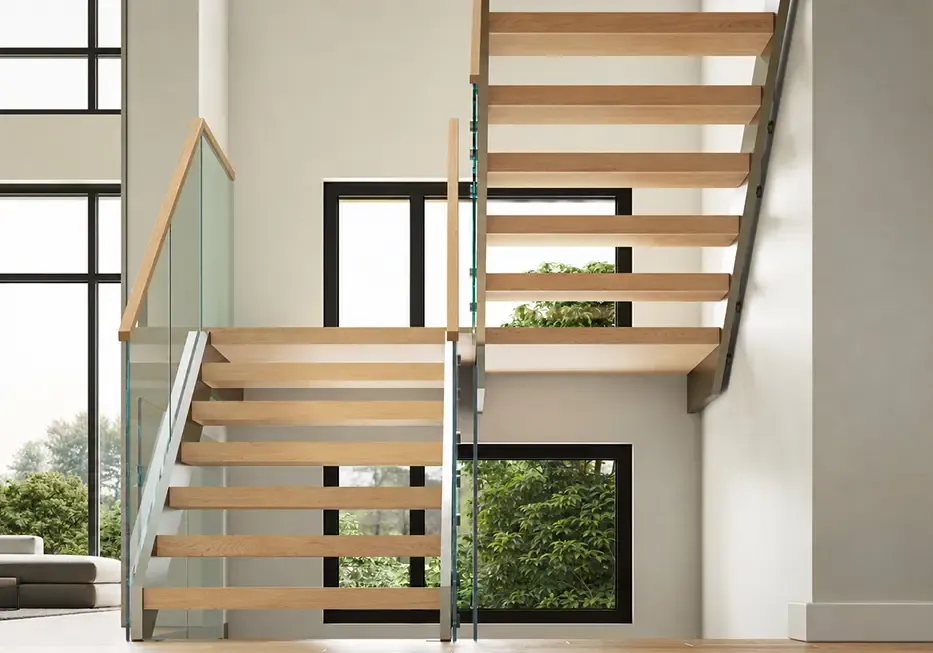
White Oak is our most specified tread material for floating staircase installations across the DC market, and for good reason. It is a ring-porous hardwood with a tight, consistent grain structure that responds to humidity changes more predictably than many other species. It is also exceptionally hard, which means it resists denting and surface wear even in high-traffic residential environments.
We source Select Grade White Oak and kiln-dry every board to a moisture content that is appropriate for DC's conditioned interior environment. Before installation, treads are delivered to your home and acclimated in the stairwell location for a minimum of seven days. That acclimation period allows the wood to reach equilibrium with your home's specific temperature and humidity conditions before it is permanently fastened. It is one of the most important steps in preventing long-term movement, and it is one that less experienced installers routinely skip.
Walnut Treads
Architectural walnut delivers a darker, richer tonal character that suits contemporary interiors, high-contrast design schemes, and homes where the staircase is intended to function as a focal point. Walnut is a moderately hard species, slightly softer than White Oak, which means it benefits from a more protective finish system in applications where heavy foot traffic is expected.
We apply the same kiln-drying and acclimation protocol to all walnut treads. Select Grade material is specified as standard, meaning minimal knots, consistent color, and straight grain throughout the tread surface.
Stone Treads
For DC penthouse renovations, modern additions, and ultra-contemporary interiors where wood simply does not fit the aesthetic, architectural stone treads offer an entirely different visual register. We work with honed limestone, polished marble, and large-format porcelain materials, all cut and finished to your exact tread dimensions.
Stone treads require a different structural approach than wood. The weight of stone per tread is significantly higher, which affects the engineering of the monostringer or cantilever bracket system beneath it. Our structural engineers account for stone tread weight from the initial design phase, ensuring the staircase spine is sized appropriately before fabrication begins.
Structural Glass Treads
Glass treads represent the most dramatic expression of the floating staircase concept. When combined with a glass railing system, a fully glazed staircase creates a visual transparency that is unlike anything else available in residential design. We fabricate structural glass treads from laminated tempered glass with a minimum thickness appropriate to the tread span and expected load.
All glass treads include an integral anti-slip surface treatment applied during fabrication. This treatment creates meaningful grip without frosting or obscuring the glass, which preserves the transparency that makes the design compelling in the first place.
Anti-Slip Finish Standards
Regardless of material, every tread we install receives an anti-slip finish treatment engineered to meet current DC residential safety standards. For wood treads, this means a penetrating or surface-applied finish system that adds grip without significantly altering the visual character of the wood. For stone treads, we apply a surface texture treatment to the nosing zone of each step. For glass treads, the anti-slip interlayer is built into the laminate stack during fabrication.
Contact Us
Contact our team to discuss tread material options for your custom floating staircase and schedule a consultation at your DC home.